Reasons for end seal and gland seal leakage
 Administrator 1December 1, 2025
A mechanical seal or a reinforced lip seal (packing), according to the manufacturer’s instructions, does not require maintenance during operation. Undoubtedly, this is an exceptional advantage for anyone using a pump with such a sealing element. But there is one BUT!
The operating instructions for the product contain clear guidelines under which conditions the hydraulic part will maintain its tightness:
- absence of “dry running,” i.e., operation of the pump without liquid present in the flow path. “Dry” operation is accompanied by rapid heating of the friction pairs and melting of the rubber bellows or rubber ring;
- bearing wear leads to increased vibrations and impact loads on the seal’s friction pairs, resulting in leakage and possible subsequent flooding of the electric motor;
- pumping liquids that contain abrasives or inclusions that may damage the seal;
- ignoring the need to flush the pump after completion of operation. When pumping liquids prone to crystallization or sticking, the pump should be flushed to prevent the friction pairs from sticking together or the edge of the rubber packing lip from adhering to the shaft.
In the photos below, you can observe the consequences of packing leakage. When pumping milk, the containers were emptied “to zero,” followed by dry running. Pump flushing was also not performed.
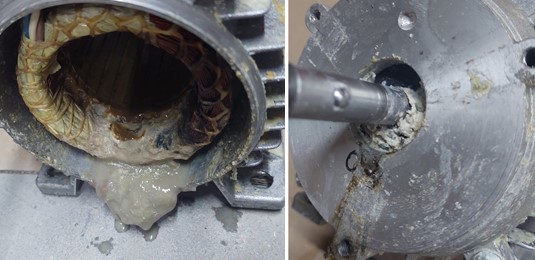
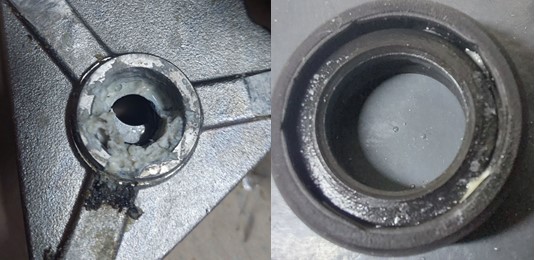
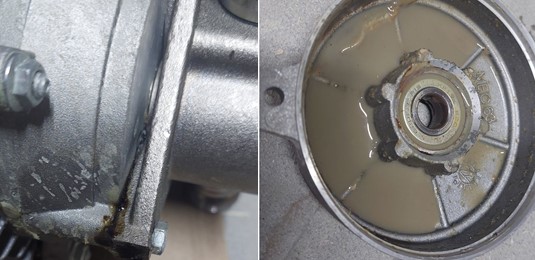
As can be seen in the photos, the pump was operated for a long time after the packing began to leak. This led to the need to rewind the motor, replace the bearings, and replace the packing.