March 2026 — Prom-nasos.com.ua
March 4, 2026
The working principle of a cam pump
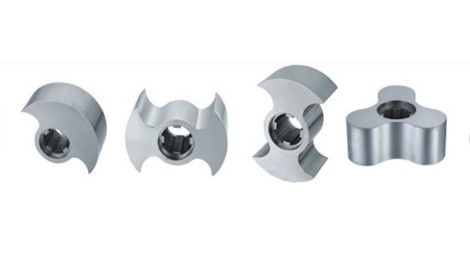
Lobe pump – a positive displacement pump. The product is transferred by means of lobes between the walls of the working chamber and the lobes.
The lobes can have different shapes depending on the pumped product, its density, and viscosity.
Features of the lobe pump:
during rotation, the lobes do not come into contact
Unlike a gear pump , where the driving gear transmits torque to the driven gear through direct contact, a minimal clearance is always maintained between the lobes and the casing.
Thanks to this feature, the pump operates quietly, and the pumping process is smooth without damaging the product.
the lobe pump operates at low speeds – from 200 to 500 rpm.
The low operating speed ensures no pulsation, does not foam the product (detergents, dairy products, various types of oils), and significantly increases the service life of bearings and mechanical seals.
can pump hot products at temperatures up to 150℃
Thanks to the special design of the mechanical seal , as well as its placement outside the working chamber, this type of pump can handle hot products with various inclusions.

March 3, 2026
Determining the volume/mass of bulk fillings

Our company has been successfully supplying random column packing of various types made from different materials for many years. In particular, these include Pall rings, Raschig rings, molecular sieves, ceramic balls, etc.
Each of these types of packing is used in various technological processes such as purification, dehydration, saturation, improvement of mass transfer, and many other processes.
The vast majority of this product is accounted for in kg (kilograms) and is accordingly shipped to the customer in kilograms. The price of the product is also indicated per 1 kg.
Customers often ask how many kilograms of a particular product need to be purchased in order to fill a given volume of a column or tank.
For bulk products, a characteristic called bulk density is used.
Bulk density is the ratio of the mass of the packing to the volume it occupies. It is measured in kg/m³.
This characteristic is indicated in the product card for each product (see the photo above). Accordingly, as follows from the formula, to determine the required mass of the packing, it is necessary to multiply the bulk density by the specified volume.
For example, you need to calculate the required mass of Raschig rings A1 25 according to GOST 17612-89 to fill a column with a volume of 2.3 m³.
Accordingly, the required mass of the packing m = 2.3 × 596 = 1370.8 kg
You can also solve the reverse problem — calculate what volume can be filled with a certain amount of packing.
If you have, for example, 200 kg of packing from the previous example, then you can fill a volume V = 200 / 596 = 0.336 m³, that is 336 liters.