July 2026 — Prom-nasos.com.ua
July 14, 2026
Pressure and Suction Pipelines
The proper and long-term operation of any pump largely depends on the piping system connected to it.
You can purchase an excellent pump with the required performance characteristics, but after commissioning, fail to achieve the desired results due to mistakes made in the selection or design of the piping system.
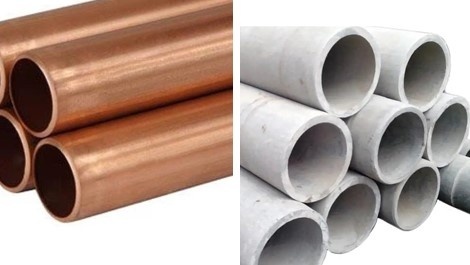
Today, the range of pipes used in various industries is extremely broad. Pipes are manufactured from steel, polymer materials, rubber, copper, concrete, glass, and even fabric.
As emphasized previously, hydraulic calculations are the basis for selecting the correct pipe diameter and material. In addition, several important factors should be considered when choosing the type of pipe.
It should be remembered that each type of pipe, in addition to its geometric dimensions, has a maximum pressure rating that the pipeline can withstand.
Pressure is the key parameter that must be considered for discharge pipelines. The pressure rating should be at least 1.5 times greater than the maximum pressure that may occur in the process system (heating, water supply, reverse osmosis, fire-fighting systems, etc.).
Another important consideration is the selection of the suction pipe. As is well known, any pump creates a vacuum in the suction line, so the suction pipeline must be rigid enough to prevent deformation that could restrict the flow of liquid.
A good example is a fire hose. Although a fire hose made of special fabric can withstand high pressures (5–10 bar) and remains flexible enough to be rolled into a coil, this type of hose is unsuitable for use as a suction line.
Suction pipelines should be made of steel, plastic, or other rigid materials. In the case of polymer hoses, they should be reinforced with a metal spring to prevent collapse under vacuum conditions.

July 13, 2026
Repair of a Peristaltic Pump
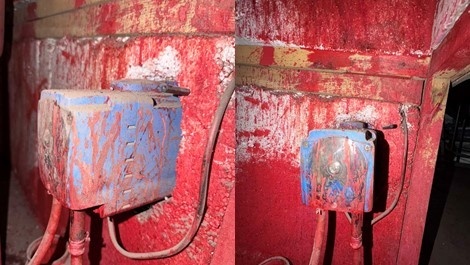
Peristaltic pumps are positive displacement pumps whose main component is a flexible hose or tube made from materials such as Santoprene, Neoprene, Tygon, and others.
This hose combines elasticity, durability, and chemical resistance to a wide range of chemicals, including crop protection products, acids, sodium hydroxide, alcohols, mash, fruit juice, oils, and more.
This component experiences the greatest wear in a peristaltic pump because it is constantly in contact not only with the pumped medium but also with the rollers that continuously compress it, causing gradual wear.
Shown below is a peristaltic dosing pump designed for supplying insecticide for the treatment of wheat grain.
The customer contacted our company for maintenance service involving the replacement of the peristaltic pump hose. The leak was detected in time, allowing the repair to be limited to hose replacement only, without the need to replace the rotor rollers.
New hose
When replacing the hose, the following simple rules should be observed:
secure the hose in the special groove in the pump housing on the suction side (as shown in this example);
secure the hose on both sides if required by the pump design and hose length (as shown in the photo below);
before installation, lubricate the hose and rollers with petroleum jelly lubricant to reduce friction;
fasten the plastic pump cover with screws to secure the hose in place.
July 11, 2026
Rules for Connecting Pipes to the Pump
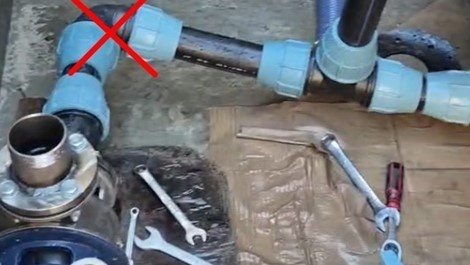
The service life of a pump directly depends on the correct connection of the piping system.
Basic piping requirements:
remember that the diameter of the pump flanges/nozzles should not be used as the basis for selecting the diameter of the connected pipe (see information here: Selection of pipe diameters connected to a pump );
the suction pipeline should be as short as possible, without elbows, bends, or reductions in diameter;
if the pump operates in suction mode from a tank or reservoir while positioned above the liquid level, a check valve must be installed at the end of the suction pipeline to prevent the liquid from draining out of the pipe after the pump stops;
always use coarse filters if there is a risk of contaminants entering the system and damaging the pump's working components (mechanical seal, impeller);
maintain the proper pipeline slope. If the pump operates in suction mode, the pipeline should slope toward the water source to prevent the formation of air pockets. If the pump operates under flooded suction conditions, the pipeline should slope toward the pump;
install shut-off valves on both the suction and discharge lines (butterfly valves, ball valves, gate valves, etc.). This is necessary not only for maintenance purposes but also, in the case of centrifugal pumps, for start-up and flow regulation;
if the pump is a high-pressure model and the discharge pipeline is relatively long, use a check valve on the discharge line to prevent water hammer;
regularly check the tightness of the piping system and prevent air leakage into the suction line, as this not only reduces pump efficiency but also accelerates wear of the pump’s working components;
do not allow the weight of the pipes and shut-off valves to be transferred to the pump casing.
Use flexible connectors, supports, and pipe stands. When pumping hot liquids, use axial bellows expansion joints to compensate for thermal expansion.
July 10, 2026
Maintenance of a Pneumatic Diaphragm Pump
Air-operated diaphragm pumps are universal positive displacement pumping equipment with a very wide range of applications, from the food industry to the chemical industry.
These pumps are highly reliable and easy to operate. The components most subject to wear during operation are the diaphragms (typically double diaphragms – 2 product-side diaphragms and 2 air-side diaphragms) and the valve assembly (seat, valve, and retaining cage).
If the pump loses performance or fails to provide sufficient pressure, it should be inspected and these components replaced if necessary.
Special attention should also be paid to the pump's air supply system. As the name suggests, the pump is driven by compressed air.
The pneumatic supply must consist of oil-free, filtered, dry, and non-lubricated compressed air.
Use air preparation units that allow pressure and flow regulation while also removing moisture and contaminants from the air.
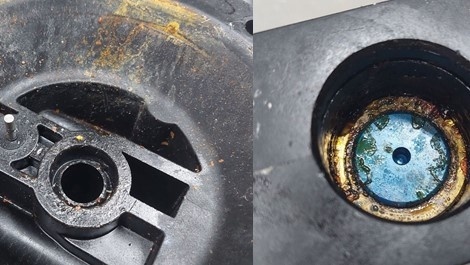
The photos below show the consequences of inadequate air preparation.
Moisture entering the pneumatic circuit caused the pilot valve and the air distribution valve piston to seize.
Fortunately, the problem was detected in time, and the pump was successfully repaired by flushing the operating components and then lubricating the moving parts with technical petroleum jelly.
Our company not only supplies pumping equipment but also provides service support through the supply of spare parts and the performance of maintenance and repair work.