May 2026 — Prom-nasos.com.ua
1. Installation location: The ambient temperature at the installation site should be 0–40 °C, and the relative humidity should be below 90%. Please choose a flat location where vibrations from other machines are not transmitted.
Leave sufficient space for maintenance.
2. Base fixation: The base area on which the pump is installed must be larger than the pump base itself. If the mounting area is too small, the pump may be damaged due to stress concentration at the contact point. The pump base must be securely fixed.
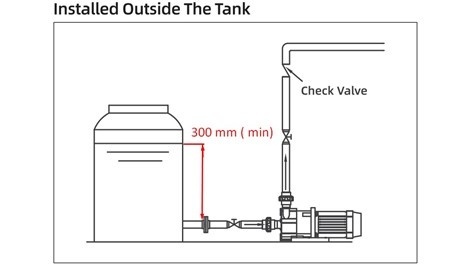
3. MD/QHX series pumps are NOT self-priming and must be installed under positive pressure conditions. The distance from the liquid surface to the suction inlet should be more than 30 cm. If the liquid head is too low, air may be drawn in, resulting in excessive wear of the pump bearings.
4. Pump discharge direction: The discharge outlet can be oriented freely, but to allow gas to escape from the pump chamber, it is recommended to direct the outlet upwards.
5. The pump head depends on the properties and temperature of the liquid, as well as the length of the suction pipeline. Keep the pipeline as short as possible and minimize the number of bends and turns.
6. Inlet and outlet valves should be installed as close as possible to the pump connections.
7. Check the voltage on the nameplate before connection. Proper grounding is mandatory.
8. The pump should be installed as close as possible to the tank and below its level (flooded suction installation).
Prohibited installation methods are shown in the figures below.
9. When the pump is used for handling hazardous liquids, flushing lines must be installed so that the internal parts of the pump can be cleaned after disassembly.

May 5, 2026
Protection of electrical equipment
The issue of electrical protection of equipment remains relevant at all times. Despite the vast amount of information on this topic and the wide range of protective devices, monitoring and control equipment, electric motors still fail.
Why does this happen? Most often, it is caused by the customer’s desire to save money on protection. Common justifications include statements such as: “Why do I need that control panel, everything works fine already,” “my old Soviet pump worked for 20 years without any problems,” “I turned it off because it keeps shutting down the pump and I have to go restart it,” and similar arguments.
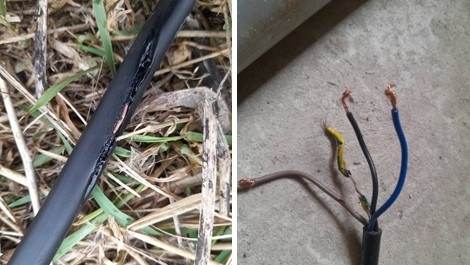
Here is an example of a typical “protection” setup for a 4 kW three-phase sewage pump.
And here is the result of such “protection”!
Another way to “burn out” your pump is to purchase a control box (protection and control panel) that supposedly has “everything included,” but fail to configure it according to your equipment parameters.
Every device, including pumping equipment and control panels, must be operated in accordance with the requirements specified in the operating manual.
As practice shows, the operating manual is often only read when there is nothing else left to read—or when everything has already burned out or seized.
Here is another example of a “warranty case.”
A borehole pump was connected through a protection and control panel , but no settings were configured.
The pump has a power rating of 4 kW, 380 V, and a nominal current of 8.8–9 A. Considering a permissible deviation of 10%, the protection current should be set to around 10 A.
However, the maximum protection current was set to 13.9 A.
And the no-load current was 8.5 A.
As a result, the pump was constantly shutting down during operation, since the no-load current was nearly equal to the nominal current, eventually leading to motor winding burnout.
Do not neglect the requirements of the operating manual! Contact our company’s specialists. We will help not only select the right equipment but also configure it correctly.
May 4, 2026
Adjusting the flow rate of a gear pump
Gear pump is a positive displacement pump. This means that the movement of the fluid (product) occurs due to a change in the volume of the working chamber.
Accordingly, the operating principle leads to the following conclusion — the flow rate of such a pump must not be regulated by closing shut-off valves on the discharge line.
When closing the valve on the discharge line, the following situations may occur:
damage to the gears
seal leakage
coupling damage
electric motor burnout
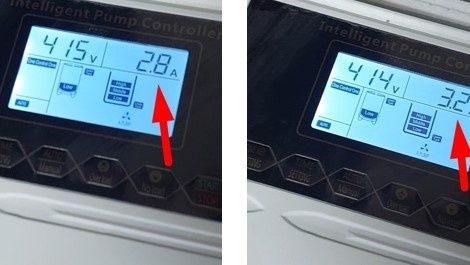
In the images below, you can observe the current consumption when the pump operates with an open line (left image) and when attempting to close the valve (right image).
When the valve is closed, the current immediately increases.
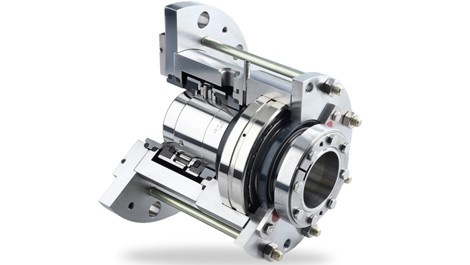
Cartridge seals are recommended for installation in pumps and mixers operating with such media as non-lubricating liquids, gases, liquids with a high concentration of solids, or those prone to crystallization, as well as adhesives, pastes, paints, and hazardous liquids.
Installation of cartridge mechanical seals:
Lubricate the shaft with a 2–3% aqueous solution of neutral liquid soap.
Slide the cartridge along the shaft until the flange contacts the housing.
Check the alignment of the seal on the shaft. Rotate the shaft by hand to detect any potential metal-to-metal noise. If the noise persists, check the shaft alignment.
Connect the appropriate lines for flushing, circulation, and barrier fluid.
This assembly requires a continuous supply of liquid, known as buffer or barrier fluid, into the chamber where the seal is installed. The pressure of the barrier fluid must be 0.5–2 bar higher than the pressure of the pumped (sealed) liquid. In case of seal failure, the barrier fluid will mix with the process liquid. This feature is especially important when the process liquid is hazardous or contaminating.
In a double cartridge seal, connect an external fluid for cooling the secondary seal.
In all cases, it is important to ensure that the process fluid contacts the seal before startup, as dry running can severely damage the sealing surfaces, even if it lasts only a short time. Although in some cases dry running cannot be avoided, special material combinations can be recommended to reduce its negative impact.
If the seal is located in the oil chamber of a pump filled with biodegradable petroleum jelly oil, this oil (lubricant) remains in the chamber continuously until the next service replacement. There is no pressure in the chamber itself.
In case of seal failure, the pumped liquid enters this chamber and mixes with the oil, which is detected by a water presence sensor (if installed).
An additional leakage chamber (motor chamber) on the motor winding side is usually empty. If pumped liquid enters this chamber, it may damage the electric motor.